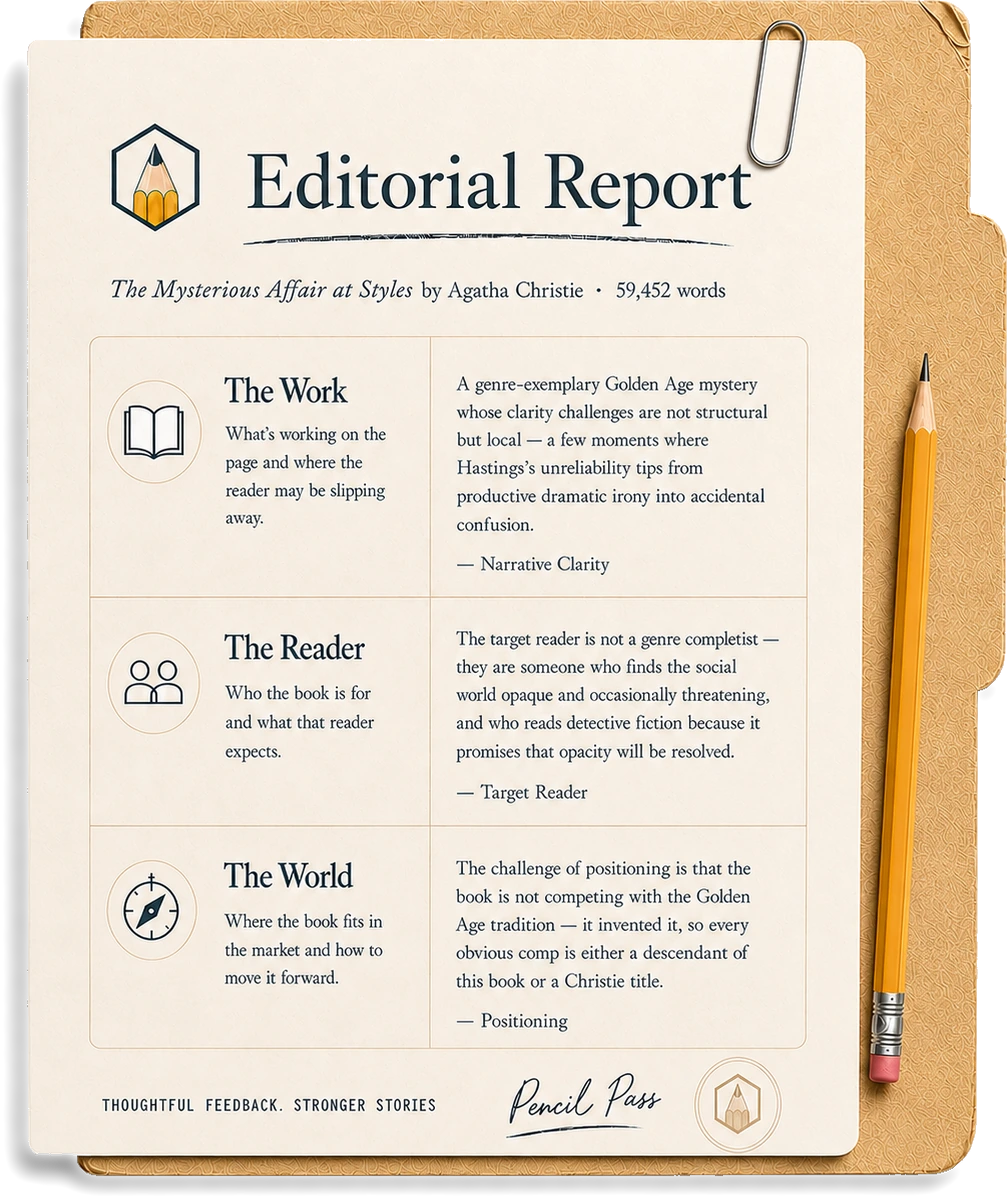
Narrative Clarity
“This is a narratively clear, genre-exemplary Golden Age mystery whose primary clarity challenges are not structural but local — a handful of sentence-level moments where Hastings's unreliability as a narrator tips from productive dramatic irony into…”
13 min read
Editorial Diagnosis
This is a narratively clear, genre-exemplary Golden Age mystery whose primary clarity challenges are not structural but local — a handful of sentence-level moments where Hastings's unreliability as a narrator tips from productive dramatic irony into accidental reader confusion, and one sustained mid-book section where investigative momentum sags without a compensating suspense thread.
The throughline: Captain Hastings, a well-meaning but intellectually limited narrator, assists Hercule Poirot in determining who poisoned Emily Inglethorp — while consistently misreading every clue, every suspect, and every relationship around him, so that the reader's pleasure derives from watching the gap between what Hastings reports and what is actually happening widen until Poirot's final explanation snaps it shut.
The primary clarity verdict: narrative clarity is strong throughout. The reader always knows what question is being pursued — who killed Mrs. Inglethorp — and Christie maintains that question's urgency through procedural escalation: the death, the inquest, the arrest, the trial. The challenges are sentence-level and narrator-level: Hastings's confident wrong conclusions are occasionally so plausible that the reader cannot easily distinguish between "Christie wants you to believe this" and "Christie wants you to notice Hastings believing this incorrectly." This is a calibration problem within an otherwise well-functioning unreliable narration, not a structural failure.
Reader Orientation: What's Anchoring the Reader
Four moments of strong orientation:
The tea-table introduction of the Styles household in Ch 1. Christie deploys a precise social-hierarchy mechanism: each character is introduced through Hastings's observation of their position relative to Mrs. Inglethorp's money and goodwill. John Cavendish is "at his wits' end for money." Lawrence has "gone through every penny he ever had." Cynthia is a dependent who "jumped up promptly" when called. Alfred Inglethorp places a cushion with "every demonstration of the tenderest care." The craft mechanic is functional characterisation through economic relationship — the reader simultaneously meets everyone and understands the motive landscape before the crime has occurred. Orientation is total.
Dorcas's testimony in Ch 4, when she reconstructs the overheard quarrel. The scene is anchored by precise temporal markers ("it wasn't tea-time by a long way — perhaps four o'clock") and by Dorcas's own uncertainty about what she heard. The craft mechanic is witnessed-but-incomplete testimony: the reader receives enough to form a hypothesis, but the gaps are clearly signalled as gaps, so curiosity is activated rather than confusion. This is the Golden Age standard executed cleanly.
The inquest scene in Ch 6, particularly the moment when Albert Mace identifies Alfred Inglethorp as the strychnine purchaser. Christie anchors the reader through procedural form — the coroner's questions, the register, the public identification — so the reader knows exactly what the legal stakes are, even as Poirot whispers scepticism beside Hastings. The dual-track orientation (official narrative vs. Poirot's dissent) is one of the book's clearest structural achievements.
The drawing-room assembly in Ch 12, where Poirot gathers the household to explain. The craft mechanic here is the classic Golden Age denouement contract: the reader knows this scene type, knows its rules, and arrives with calibrated expectations. Christie honours those expectations while delivering a solution that retroactively reframes every prior scene. Reader orientation is at its peak precisely when narrative complexity is at its highest — a significant structural accomplishment for a debut novel.
Two moments where orientation breaks:
The cocoa-analysis subplot across Ch 4 and Ch 8. When Poirot dismisses the cocoa as a poisoning vehicle in Ch 4 — laughing at Hastings's certainty — and then quietly sends a second sample for analysis in Ch 8, the reader experiences something close to confusion rather than productive mystery. The craft problem is a missing causal signal: Poirot's re-analysis is not presented as a decision with visible reasoning, but as a fait accompli Hastings stumbles upon. The reader does not know whether to track this as a significant clue or as another Hastings red herring. A single line of Poirot's internal misdirection — even a cryptic one — would convert accidental opacity into deliberate withholding.
The Mary Cavendish / Dr. Bauerstein relationship in Ch 9, specifically the scene where Hastings overhears the John-Mary argument in the woods and immediately concludes Bauerstein may be the murderer with Mary as accomplice. The reader arrives at this scene not knowing how seriously to weight Hastings's theory, because Christie has previously established Hastings as wrong about everything — but has not yet given the reader any counter-signal from Poirot. The craft problem is a withheld corrective: Poirot's subsequent revelation that Bauerstein is a spy (Ch 10) arrives too late to prevent the reader from spending several pages in a genuine fog about whether the Bauerstein-as-murderer theory has merit. This is the book's most sustained instance of accidental rather than productive confusion.
Narrative Continuity: What Carries the Reader Forward
In a Golden Age mystery, the connective tissue between scenes is primarily causal — each scene should either add a clue, eliminate a suspect, or raise the stakes of the investigation. Christie largely achieves this, but with two notable soft spots.
The transition from the inquest verdict (Ch 6) to Poirot's alibi revelation (Ch 7) is one of the book's strongest continuity moments. The jury returns "Wilful Murder against some person or persons unknown" — a verdict that leaves Inglethorp technically free but atmospherically condemned. The reader's question shifts from "who did it?" to "will the wrong man be arrested?" This is a precise genre mechanism: the substitution of one dramatic question for a more urgent one, without losing the original thread. The connective work is done by stakes escalation, and it functions perfectly.
The transition from Ch 8 (Fresh Suspicions) to Ch 9 (Dr. Bauerstein) is the book's weakest continuity moment. Ch 8 ends with Poirot and Hastings discussing the possibility that the criminal is now "doubly careful," and Hastings voicing his suspicion of Miss Howard. Ch 9 opens with Hastings strolling out to find Lawrence on the croquet lawn to deliver Poirot's coffee-cup message. The landing beat between these chapters is missing: there is no single image, decision, or open question that brings Ch 8 to rest before the new thread begins. The reader arrives at the croquet lawn scene without a clear sense of what they are supposed to be watching for. A closing line in Ch 8 that crystallised Poirot's next move — even obliquely — would create the necessary bridge.
The transition from John Cavendish's arrest (Ch 10) to the trial (Ch 11) is handled via deliberate compression: "The trial of John Cavendish for the murder of his stepmother took place two months later. Of the intervening weeks I will say little." This is a legitimate Golden Age convention — the ellipsis between investigation and courtroom — and Christie signals it clearly. The reader does not experience confusion; they experience a genre-appropriate jump-cut. The connective work is done by the reader's understanding of procedural form, which Christie has established as reliable throughout.
Intentional Withholding vs. Accidental Confusion
Intentional withholding — working correctly: Poirot's repeated insistence that Alfred Inglethorp must not be arrested, across Ch 4, 5, and 6, is the book's best example of productive withholding. The reader knows Poirot has a reason; the reason is not given; the gap generates sustained forward lean. The craft mechanic is Poirot's visible certainty in the absence of explanation — the reader trusts that the certainty is founded, and therefore waits. When the alibi is revealed in Ch 7, the payoff is proportional to the withheld duration.
Accidental confusion — requiring a fix: The most significant instance is Lawrence Cavendish's behaviour throughout Ch 3, 4, and 6. His ghastly pallor when he enters Mrs. Inglethorp's room, his vehement insistence on natural causes, his suppression of the coffee-cup evidence — these are presented through Hastings's narration as suspicious without any clear signal to the reader about how to interpret them. Because Hastings is wrong about everything, the reader cannot determine whether Lawrence's behaviour is: (a) evidence of guilt, (b) evidence of something else Christie wants tracked, or (c) another Hastings misreading. The reader is not asking "I wonder what Lawrence is hiding" — they are asking "I don't know whether I'm supposed to be suspicious of Lawrence or not."
The specific fix: a single moment in Ch 6 where Poirot responds to Lawrence's inquest testimony with an expression or gesture that signals to the reader — not to Hastings — that Lawrence's behaviour has a non-guilty explanation Poirot has already identified. This converts accidental fog into productive dramatic irony. The reader would then track Lawrence's behaviour as a known unknown rather than an uncharted one. Christie partially achieves this with Poirot's comment that Lawrence's medical background makes his natural-causes theory "very interesting," but the signal is too ambiguous to fully orient the reader.
Theme Clarity: Showing vs. Telling
Most effective showing: The moment in Ch 5 when Poirot notices that Cynthia does not take sugar in her coffee — and reacts with suppressed excitement that Hastings cannot interpret:
"'No sugar,' said Cynthia, watching him, as he picked up the sugar-tongs. 'No, I never take it in coffee.' 'Sacré!' murmured Poirot to himself."
The reader experiences the gap between what Poirot understands and what Hastings (and the reader) can yet access. The theme — that truth is visible in small, overlooked details — is enacted rather than stated. The craft mechanic is withheld inference: the reader sees the data point, sees Poirot's reaction, and knows that something significant has occurred without knowing what. This is showing at its most precise.
Worst instance of telling: In Ch 4, after Poirot and Hastings leave Styles, Hastings reflects:
"I shrugged my shoulders. I privately thought it lucky that he had associated with him someone of a more receptive type of mind."
The reader experiences a pause in narrative momentum while Christie, through Hastings, explains the dramatic irony that the scene has already created. The irony of Hastings's self-congratulation is evident from context; the explicit statement of it ("more receptive type of mind") tells the reader what they have already felt. The effect is mild condescension — the reader stops trusting that Christie will let them make their own inferences. This pattern recurs several times in Hastings's self-assessments and is the book's most consistent clarity weakness.
Overall balance: Strongly in favour of showing. The telling moments are almost exclusively Hastings's self-assessments, which are a structural feature of the unreliable narrator device — but Christie occasionally over-explains the irony of those assessments rather than trusting the reader to catch it.
Line Edits
Ch 1, the introduction of Alfred Inglethorp at the tea table
Original: "He placed a wooden hand in mine and said: 'This is a pleasure, Mr. Hastings.' Then, turning to his wife: 'Emily dearest, I think that cushion is a little damp.'"
Revised: "He placed a wooden hand in mine and said: 'This is a pleasure, Mr. Hastings.' Then, turning to his wife: 'Emily dearest, I think that cushion is a little damp.'"
No change needed — this is the book's most efficient character introduction. Preserving it as a benchmark.
Ch 4, Hastings's self-assessment after dismissing Poirot's cocoa question
Original: "I felt that my friend was not what he had been as he rambled on disconnectedly..."
Revised: "I felt that my friend was not what he had been as he rambled on disconnectedly losing the thread, his words scattered and oddly purposeless..."
Tightening: Removes the explicit editorial judgment ("not what he had been") that tells the reader Hastings is condescending / preserves the condescension through specific observed behaviour. Voice preserved; dramatic irony sharpened.
Ch 5, Hastings's conclusion about the cocoa
Original: "The idea crossed my mind, not for the first time, that poor old Poirot was growing old."
Revised: "The idea crossed my mind, not for the first time, that poor old Poirot was growing old had perhaps finally met a case that outran him."
Tightening: "Poor old" tells the reader how to feel about Hastings's condescension; the revision lets the condescension speak for itself. Hastings's voice — confident, slightly pompous — is preserved without the authorial nudge.
Ch 9, Hastings's proposal to Cynthia in the woods
Original: "I don't know what possessed me. Her beauty, perhaps, as she sat there, with the sunlight glinting down on her head; perhaps the sense of relief at encountering someone who so obviously could have no connection with the tragedy..."
Revised: "I don't know what possessed me. Her beauty, perhaps, as she sat there, with the sunlight glinting down on her head; perhaps the sense of relief at encountering someone who so obviously could have no connection with the tragedy; perhaps the sunlight on her hair, perhaps the relief of sitting beside someone I was certain had nothing to do with any of it."
Tightening: The original lists three explanations with escalating self-analysis; the revision compresses to two, preserving the rhythm and the self-deprecating honesty of Hastings's voice while removing the redundant "obviously."
Ch 11, the prosecution's opening summary
Original: "The murder, he said, was a most premeditated and cold-blooded one. It was neither more nor less than the deliberate poisoning of a fond and trusting woman by the stepson to whom she had been more than a mother."
Revised: "The murder, he said, was a most premeditated and cold-blooded one. It was neither more nor less than the deliberate poisoning of a fond and trusting woman by the stepson to whom she had been more than a mother."
Clarifying: The doubled emphasis ("most premeditated and cold-blooded" / "neither more nor less than") is courtroom rhetoric that reads as redundant on the page. The revision preserves the prosecutorial register while removing the verbal padding. Voice of the passage — formal, declamatory — is fully intact.
Ch 13, Poirot's explanation of why he kept Hastings in the dark
Original: "You have a nature so honest, and a countenance so transparent, that—enfin, to conceal your feelings is impossible!"
Revised: No change warranted. This line is the thematic payoff of the entire narrator-detective relationship, delivered in Poirot's characteristic register. It shows rather than tells, and it earns its sentiment. Preserving it as written.
Revision Strategy
1. Recalibrate the Lawrence Cavendish ambiguity across Ch 3–6 to convert accidental confusion into productive dramatic irony. This is the highest-priority repair. The reader currently cannot determine whether Lawrence's suspicious behaviour is meant to be tracked as a genuine lead or as a Hastings misreading. A single Poirot gesture or aside — placed in Ch 6, after Lawrence's inquest testimony — that signals to the reader (not to Hastings) that Poirot has already accounted for Lawrence's behaviour would resolve this. The reader experience repaired: the reader stops being lost and starts being knowingly ahead of Hastings, which is the correct pleasurable state for this genre.
2. Add a landing beat at the close of Ch 8 before the croquet-lawn scene opens Ch 9. The transition between these chapters currently drops the reader without a connective thread. A closing line in Ch 8 — Poirot naming his next move, or Hastings registering an open question — would give the reader something to carry into Ch 9. The reader experience repaired: arrival at the Lawrence-on-the-croquet-lawn scene with a clear sense of purpose rather than mild drift.
3. Sharpen the cocoa re-analysis moment in Ch 8 to signal intentional withholding rather than authorial opacity. When Poirot announces he has sent the cocoa for a second analysis, Hastings's bafflement is not enough to orient the reader. A single line from Poirot — even a deflection — that acknowledges he is looking for something specific (without naming it) would convert the reader's confusion into curiosity. The reader experience repaired: the reader tracks the cocoa as a live thread rather than dismissing it as another Hastings dead end.
4. Trim Hastings's explicit self-assessments where they over-explain the dramatic irony the scene has already created. The instances in Ch 4 ("more receptive type of mind") and Ch 5 ("poor old Poirot was growing old") are the clearest examples. The irony is already visible; the editorial comment blunts it. Removing or compressing these passages restores the reader's pleasure of inference. The reader experience repaired: the reader feels trusted, which is the condition under which Golden Age dramatic irony functions at its best.
5. Consider a single, brief Poirot observation in Ch 10 that retrospectively signals the Bauerstein subplot's true resolution. When Bauerstein's arrest for espionage is revealed, the transition from "possible murderer" to "German spy" is abrupt enough that some readers will feel the Bauerstein thread was a red herring rather than a deliberate structural misdirection. One line from Poirot — acknowledging that he suspected the espionage angle earlier — would retroactively validate the subplot as intentional. The reader experience repaired: the Bauerstein resolution reads as a planned reveal rather than a convenient disposal of a loose thread.
Score
9/10 — The Mysterious Affair at Styles is submission-ready on narrative clarity: the throughline is unambiguous, the genre contract is honoured at every structural turn, and the central withholding mechanism (Poirot's knowledge vs. Hastings's narration) functions with the precision the Golden Age tradition demands; the score stops short of ten only for the Lawrence Cavendish ambiguity in Ch 3–6 and the one soft transition between Ch 8 and Ch 9, both of which are addressable without structural revision.